
With the 2026 edition of Challenge Roth approaching, athletes face what is renowned as one of the fastest, yet challenging bike course in long-course triathlon. Spanning 180 km through the rolling, picturesque Franconian countryside, the course demands a highly strategic approach to power management. While frequently characterized as a lightning-fast track, it presents significant rhythm changes, legendary crowd-lined climbs, and high-speed sections that heavily penalize improper pacing execution.
Riding a full-distance 180 km course at a constant, flat power output is structurally inefficient. To separate long-course pacing myths from real-world physics, we leveraged the Swiss Side Performance Platform to evaluate how strategic power distribution affects the clock and protects an athlete's legs for the subsequent marathon.
The Course Physics Profile
- The Distance: Approximately 180 km (2 loops of 90 km).
- The Profile: Hilly, rolling terrain with fast, wind-exposed flats and punchy, iconic climbs.
- The Key Sectors: High-speed flat stretches, the gradual drag of the Kränzleinsberg, the short and electric atmosphere of Solar Hill, and the long, grueling climb up the Gredinger Kalvarienberg featuring steep gradients up to 9%.
For this case study, we modeled a standardized age-grouper profile (70 kg rider, 180 cm) with a triathlon bike (10 kg) and a CdA of 0.320 base bars / 0.250 aerobars targeting a Normalized Power (NP) of 220 W to see how pacing execution affects the clock.
We used the pre-segmented course in the official course database of the Swiss Side Performance Platform and made use of the automatic wind forecast to get recommendations that are tailored to the conditions on race day (July 5, 08:00).
Shaving Minutes in Roth: The Data-Driven Pacing Strategy
Riding Challenge Roth at a constant power output is not optimal. Instead, you should use your energy more wisely. Using the Swiss Side Performance Platform's auto-grouping feature, the 59 course segments are divided into intelligent, memorable groups optimized for a pacing strategy that maximizes speed for the provided power budget of 220 W Normalized Power.
The result is a strategy where you must push more on the climbs and conserve energy on the descents. The key principle is to maximize power where speed is low (climbs) and conserve power where speed is high (descents and flats), using the physics of aerodynamic drag and gravity to your advantage.
-
On Steep Climbs & Iconic Hills: Tactical Over-Pacing. On the steepest sections of the Roth course, such as the 9% pitches of the Gredinger Kalvarienberg or the wall of spectators on Solar Hill, the simulation engine recommends a tactical over-pacing strategy of +38W to +51 W above the 220 W reference. Pushing on these slow segments maximizes time efficiency where gravity is working directly against the system mass.
-
Across the Flats: Controlled Power Management. On the pure windless flats, athletes must lock into their aerobars and hold slightly below reference power at 214 W (-6 W). When localized headwinds are encountered, the platform advises increasing output power slightly to 215 W (-4.9 W).
-
High-Speed Descents: Active Recovery. On descents, pushing high watts is counter-productive. The platform prescribes a highly controlled under-pacing strategy of -70 W (150 W target). This intentional drop in power allows recovery with minimal impact on the overall time.
The Bottom Line: By dynamically adapting power output to match the topography of the Challenge Roth course, the simulated athlete achieves a profound pacing benefit. Remarkably, the optimized strategy is 2 minutes and 8 seconds faster than a flat, constant power strategy while keeping the overall physiological power (Normalized Power) perfectly locked at 220 W. This means the rider achieves a faster overall bike split for the same biological toll, entering Transition 2 with fresh legs ready to dominate the marathon run.
 The optimal pacing strategy for the simulated rider setup, as presented by the Swiss Side Performance Platform.
 Comparison between a constant power strategy and the optimized pacing strategy, as presented by the Swiss Side Performance Platform.
Best wheel setup
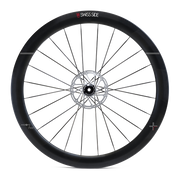
The simulation engine shows that the optimal setup for this hilly course is a deep section aero front wheel paired with a rear disc. In our database the fastest wheel setup is the HADRON³ Ultimate 850 Front Wheel with Continental AERO 111 29c tyre and the HADRON³ Ultimate Rear DISC with Continental GP5000 S TR 28c tyre. However, the time penalty for riding without a rear disc is relatively small, less than 1 minute over the full 180 km course compared to the HADRON³ Ultimate 850 rear wheel.
Get Your Personal Race-Day Blueprint
If you want to know about the pacing and equipment choice for your personal profile and setup, try the Swiss Side Performance Platform.
You can test the platform for 10 days by starting a free trial of our PRO plan. Crucially, you do not have to provide any payment information and there is no automatic subscription at the end of the trial.
Stop relying on simplified rules of thumb or race-day guesswork. Input your specific weight, bike setup, and your power target to generate a customized, scientifically proven map to your next PR.
Learn more about the Swiss Side Performance Platform and start your unbinding free trial here.