
With the 2026 edition of IRONMAN Frankfurt right around the corner, athletes are gearing up to tackle one of Europe’s most iconic, high-energy, and deceptively challenging bike courses. Journeying from the Langener Waldsee, cutting through the urban skyline of "Mainhattan," and expanding out into the rolling Hessian countryside, this course demands respect. Spanning roughly 175 km, it presents an array of high-speed flats, intense spectator hotspots, and sudden, rhythm-breaking climbs that will heavily penalize anyone executing an improper pacing plan.
Riding a multi-loop course like Frankfurt at a rigid, flat power output is structurally inefficient. To separate long-course pacing myths from real-world physics, we leveraged the Swiss Side Performance Platform to evaluate how strategic power distribution alters the clock and protects an athlete's legs for the subsequent marathon along the Main River.
The Course Physics Profile
- The Distance: Approximately 175 km (an initial inline section followed by 2 loops).
- The Profile: Fast and rolling, featuring roughly 1,300 meters of total elevation gain, characterized by quick transitions between flat stretches and punchy hills.
- The Key Sectors: High-speed flat sections through the city and crop fields, the legendary crowd-lined climb of "The Beast", the brutal, bottle-shaking cobblestones of "The Hell", and the roaring, decisive wall of "Heartbreak Hill".
For this case study, we modeled our standardized age-grouper profile (70 kg rider, 180 cm) with a triathlon bike (10 kg) and a CdA of 0.320 on the base bars / 0.250 on the aerobars. We targeted a Normalized Power (NP) of 220 W to observe exactly how dynamic pacing optimization impacts overall performance.
We used the pre-segmented course in the official course database of the Swiss Side Performance Platform and made use of the automatic wind forecast to get recommendations that are tailored to the conditions on race day (June 28, 08:00).
Shaving Minutes in Frankfurt: The Data-Driven Pacing Strategy
Trying to hold exactly 220 W across Frankfurt's shifting topography isn't just difficult, it is physically slower. Using the platform’s auto-grouping feature, we divided the 55 course segments into intelligent, memorable groups to optimize speed for our 220 W normalized power budget. The core physics principle remains absolute: maximize power where your speed is low (climbs) to fight gravity efficiently, and conserve power where your speed is high (descents and flats) to avoid wasting energy against exponential aerodynamic drag.
The optimized breakdown reveals exactly how you should distribute your effort:
-
Taming "The Beast", "The Hell" & "Heartbreak Hill": Tactical Over-Pacing: When hitting the uphill segments of the course, gravity becomes your primary resistance. The simulation recommends pushing +27 W to +36 W above your reference. This controlled, purposeful surge is exactly how you conquer famous humps like "The Beast", "The Hell" and "Heartbreak Hill" without blowing up your matches early.
-
Navigating Descents: Active Recovery: On downhills, pushing big watts yields minimal speed returns because aero drag increases exponentially. The system prescribes an under-pacing strategy of 194 W (-26 W) to 203 W (-17 W).
-
Managing the Flats: Controlled Output: The flat sections make up the vast bulk of the mileage. The platform advises a subtle under-pacing strategy depending on the breeze: a highly managed 215 W (-5 W) on the headwind sections, and dropping down to 208 W (-12 W) on the tailwind sections where your momentum is already working for you.
The Bottom Line: By dynamically adapting your power output to match Frankfurt’s topography and wind conditions, the rewards are immediate. The optimized strategy shaves an impressive 1 minute and 44 seconds off the bike split compared to a rigid, constant power strategy.
Even better? Your average power actually drops to 218 W while the Normalized Power stays perfectly locked at 220 W. You ride faster, finish sooner, and burn less raw metabolic energy, meaning you enter Transition 2 with the physiological freshness required to execute a stellar marathon.
 The optimal pacing strategy for the simulated rider setup, as presented by the Swiss Side Performance Platform.
 Comparison between a constant power strategy and the optimized pacing strategy, as presented by the Swiss Side Performance Platform.
Best wheel setup
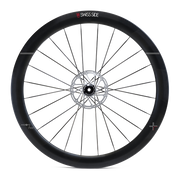
The simulation engine shows that the optimal setup for this hilly course is a deep section aero front wheel paired with a rear disc. In our database the fastest wheel setup is the HADRON³ Ultimate 850 Front Wheel with Continental AERO 111 29c tyre and the HADRON³ Ultimate Rear DISC with Continental GP5000 S TR 28c tyre. While the rear disc gives you the maximum aerodynamic sailing effect on the windy flats, if you choose to run a deep-rim HADRON³ Ultimate 850 rear wheel instead, the time penalty is relatively small over the full 180 km course (less than 1 minute).
Get Your Personal Race-Day Blueprint
If you want to know more about the pacing and equipment choice for your personal profile and setup, try the Swiss Side Performance Platform.
You can test the platform for 10 days by starting a free trial of our PRO plan. Crucially, you do not have to provide any payment information and there is no automatic subscription at the end of the trial.
Stop relying on simplified rules of thumb or race-day guesswork. Input your specific weight, bike setup, and your power target to generate a customized, scientifically proven map to your next personal best.
Learn more about the Swiss Side Performance Platform and start your unbinding free trial here.