
With the breathtaking IRONMAN Thun on the horizon, athletes face a stunning yet deceptively challenging bike course in the heart of Switzerland. Slicing alongside the pristine waters of Lake Thun before heading into rolling countryside with the majestic Bernese Oberland peaks as a backdrop, this course demands both raw power and tactical intelligence.
For many, the varied layout sparks a familiar transition-area debate: Is it better to choose a lightweight, agile road bike to conquer the punchy Swiss climbs, or go full aero with a triathlon bike to smash the long lakeside flats? Furthermore, with shifting wind conditions and changing gradients, how should you distribute your power to finish as fast as possible without destroying your legs for the marathon?
To replace speculation with pure physics, we conducted a comprehensive simulation of the Thun bike course using the Swiss Side Performance Platform. Here is your data-driven blueprint for equipment selection and power management.
The Course Physics Profile
-
The Distance: Approximately 180 km (2 loops of 90 km).
-
The Profile: A dynamic mix of long, high-speed flats and prolonged rolling sections, punctuated by steady, grinding alpine ascents (with a total elevation gain of more than 2,000 metres) and fast descents.
-
The Key Sectors: The course launches out of Thun along the pristine shores of the lake towards Spiez. Turning away from the water, the route heads deep into the Gürbe Valley (Gürbetal) towards Bern Airport and the rugged Gantrisch banking area. Once the climbing is done, a smooth, high-speed descent allows athletes to safely pocket some recovery before looping back to transition.
For this case study, we modeled a standardized age-grouper profile (70 kg rider, 180 cm) targeting a Normalized Power (NP) of 220 W to analyze exactly how equipment selection and pacing execution alter the clock.
We used the pre-segmented course in the official course database of the Swiss Side Performance Platform and made use of the automatic wind forecast to get recommendations that are tailored to the conditions on race day (July 5, 08:00).
The Gear Battle: Road Bike vs. Tri Bike
It is easy to look at the rolling hills and steady climbs of the Swiss landscape and instinctively consider a nimble road bike. However, our virtual head-to-head simulation reveals that a dedicated Triathlon/TT setup heavily outpaces a road setup over the total distance by a staggering 12 minutes and 46 seconds.
| Metric | Setup A (Road Bike) | Setup B (Triathlon/TT Bike) | Delta |
| System Weight | Lower (8 kg bike) | Higher (10 kg bike) | +2 kg Weight Penalty |
| Aerodynamic Drag (CdA) | Higher (0.400 hoods / 0.300 drops) | Lower (0.320 base bars / 0.250 aerobars) | Significant Aero Advantage |
| Estimated Simulated Finish Time | 05:19:18 | 05:06:32 | TT is around 12min 46s faster |
Platform Insight: The time deficit for the road bike grows massively across the flatter, high-speed sections of the Thun course. Crucially, gravity rarely takes over enough to give the road bike an advantage here. Even on the steady climb (4% gradient), the triathlon bike still holds a 17-second advantage because aerodynamic drag remains a major factor at these speeds. There is no section on this course where the road bike claws back time; the aero advantage of the TT setup dominates from start to finish.
 Comparison between the Triathlon and Road setup for different groups, as presented by the Swiss Side Performance Platform, showing that the Triathlon setup is faster on all segments.
The Perfect Pacing Strategy: Conquering the Bernese Oberland
Riding a varied course like Thun at a completely constant power output is highly inefficient. Using the platform's auto-grouping feature, we divided the 47 course segments into intelligent, memorable groups to optimize speed for our 220 W normalized power budget.
The core physics principle here is simple: over-pace (push higher watts) when your speed is low because you spend more time on the climbs, and under-pace (save watts) when your speed is high to avoid wasting energy against exponential aerodynamic resistance.
By implementing the optimized power targets, athletes can execute the distinct phases of the course perfectly:
-
On the Climbs & False Flats: Push. When the road points up, gravity becomes a primary opponent. The simulation recommends an aggressive over-pacing strategy of +16 W to +28 W above your reference power on the climbs. Pacing hard here ensures you minimize the total time spent dragging weight up the terrain.
-
Across the Flats: Hold Steady & Stay Aero. On flat sections, your priority is minimizing your frontal area. Tuck deep into your aerobars and let aerodynamics do the heavy lifting while saving a fraction of your energy.
-
On the Descents: Recover. Trying to push big watts while flying down descents yields diminishing returns due to exponential aerodynamic drag. The platform advises dropping your power significantly by -67 W, or coasting entirely when spinning out your gear. This allows you to flush out lactate, drop your heart rate, and preserve glycogen.
The Bottom Line: The overall impact of this strategic energy distribution is striking. Deploying your energy precisely where the physics demands it allows you to complete the Thun bike course 2 minutes and 6 seconds faster for the exact same physical cost (220 W NP).
 The optimal pacing strategy for the simulated rider setup, as presented by the Swiss Side Performance Platform.
 Comparison between a constant power strategy and the optimized pacing strategy, as presented by the Swiss Side Performance Platform.
Best wheel setup
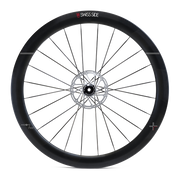
The simulation engine shows that the optimal setup for this hilly course is a deep section aero front wheel paired with a rear disc. In our database the fastest wheel setup is the HADRON³ Ultimate 850 Front Wheel with Continental AERO 111 29c tyre and the HADRON³ Ultimate Rear DISC with Continental GP5000 S TR 28c tyre. However, the time penalty for riding without a rear disc is relatively small, less than 1 minute over the full 180 km course compared to the HADRON³ Ultimate 850 rear wheel.
Get Your Personal Race-Day Blueprint
If you want to know about the pacing and equipment choice for your personal profile and setup, try the Swiss Side Performance Platform.
You can test the platform for 10 days by starting a free trial of our PRO plan. Crucially, you do not have to provide any payment information and there is no automatic subscription at the end of the trial.
Stop relying on simplified rules of thumb or race-day guesswork. Input your specific weight, bike setup, and your power target to generate a customized, scientifically proven map to your next personal best.
Learn more about the Swiss Side Performance Platform and start your unbinding free trial here.